In recent months, it has become clear that one large language model is powerful — but not universal. Real business processes are rarely linear. They require iteration, validation, refinement, and alignment with regulatory requirements and internal company policies.
This is why services built on the low-code platform Botman.one increasingly rely on multiple LLMs working within a single workflow — each with a clearly defined role.
Why One Model Is Often Not Enough
A typical applied task (for example, drafting a contract or analyzing HR risks) consists of several stages:
-
Creating a basic structure or draft.
-
Incorporating industry-specific, tax, or regulatory requirements.
-
Checking for logical inconsistencies.
-
Final editing and harmonization.
One model can attempt to handle all these steps sequentially. However, without role separation, it may lose context, contradict itself, or overlook important details.
When the process is decomposed and different models are assigned specific functions, the result becomes more stable and predictable.
Example: Drafting an International Trade Contract
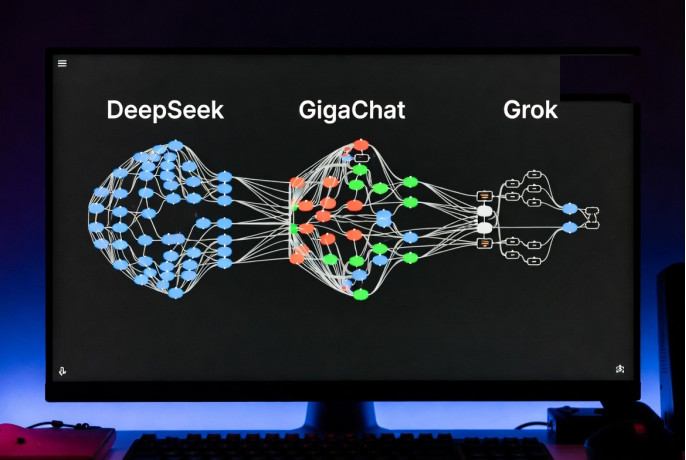
In the demonstrated scenario, three different models are used:
-
DeepSeek — prepares the initial draft of the supply agreement.
-
GigaChat — generates recommendations considering currency control, tax, and customs regulations.
-
Grok — reviews both outputs, resolves inconsistencies, and produces the final version.
The key idea is role allocation:
-
The first model focuses on structure and drafting.
-
The second concentrates on regulatory sensitivity.
-
The third performs critical review and integration.
This setup mirrors how a legal team operates in practice: a junior lawyer drafts, a compliance specialist reviews, and a supervising partner finalizes.
On Botman.one, such orchestration is implemented through sequential workflow blocks — without programming, using configurable prompts and data routing.
Practical Advantages of the Multi-LLM Approach
1. Separation of Cognitive Roles
Each model specializes in a defined function, reducing contextual overload and logical drift.
2. Managed Iteration
You can:
-
send outputs back for revision,
-
add automated validation steps,
-
track intermediate versions,
-
preserve structured reasoning.
The process becomes transparent and controllable.
3. Built-In Internal Audit
A third model acting as a reviewer can detect:
-
contradictions,
-
vague formulations,
-
regulatory risks,
-
terminology inconsistencies.
This is particularly valuable for legal and compliance-heavy tasks.
4. Leveraging Different Strengths
Different LLMs have different advantages:
-
some are better at structured drafting,
-
others are more precise with regulatory analysis,
-
others excel at critical reasoning.
Orchestration allows deliberate use of these strengths.
5. Reduced Operational Risk
If one model makes an error, the likelihood that another model will detect it increases significantly. This adds an additional control layer.
Practical Use Cases for Legal Teams
1. Compliance Review of Internal Policies
Workflow example:
-
Model A analyzes an internal regulation.
-
Model B compares it with current legal requirements.
-
Model C generates a structured risk report.
The result is a prioritized legal risk map rather than scattered comments.
2. Litigation Strategy Preparation
-
The first model formulates a legal position.
-
The second identifies weaknesses and possible counterarguments.
-
The third strengthens the argumentation accordingly.
This simulates courtroom debate before filing documents.
3. Due Diligence
-
Model 1 structures the collected documentation.
-
Model 2 highlights anomalies and risk zones.
-
Model 3 produces a final executive summary.
Practical Use Cases for HR
1. Recruitment Screening
-
The first model analyzes CVs and produces structured summaries.
-
The second matches candidates against role profiles and competencies.
-
The third generates interview questions and risk hypotheses.
This transforms resume flows into a structured analytical funnel.
2. Job Description Development
-
Model 1 drafts responsibilities.
-
Model 2 checks labor law compliance.
-
Model 3 adapts the description to market positioning and employer branding.
3. Turnover Analysis
-
The first model aggregates exit interview feedback.
-
The second detects recurring patterns.
-
The third formulates managerial recommendations.
Why Low-Code Matters
Orchestrating multiple LLMs is not only a conceptual decision but also a technical challenge:
-
passing context between stages,
-
storing intermediate results,
-
routing data across steps,
-
managing versions,
-
configuring iterative logic.
Without low-code tools, this becomes a full-scale development project.
With low-code, it becomes a configurable workflow that can be assembled by a business analyst, lawyer, or HR specialist who understands the process but does not write code.
The Core Insight
The value is not in connecting three models instead of one.
The value lies in process architecture:
-
task decomposition,
-
clear role distribution,
-
independent validation,
-
controlled iteration.
This approach reflects how expert teams actually work.
As business processes grow more complex, model orchestration becomes a more sustainable strategy than relying on a single universal AI system.