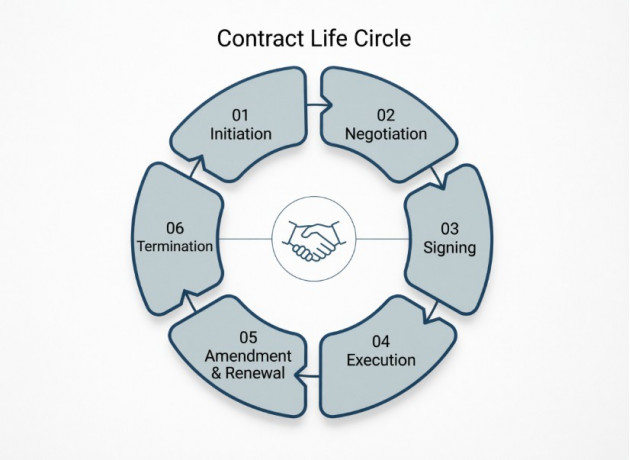
For years, the core LegalTech discussion in Russia revolved around the contract signing process: drafting, negotiating, approving, signing, and storing legal documents. This was a natural development, since electronic document management systems became the first real step toward digital transformation for many legal departments.
Today, the situation is changing. Businesses are operating under increasing uncertainty, and legal teams are facing a different type of challenge. The key question is no longer how to sign a contract, but what happens after it has been signed.
That is why the legal function is gradually shifting toward the next stage of the contract lifecycle — post-signature contract management.
Why Contract Storage Is No Longer Enough
Even if a company has built a perfect contract approval and signing workflow, one major problem remains: once the document is signed, it often disappears from active management.
Meanwhile, real obligations are scattered across email threads, Excel files, accounting tools, CRM systems, operational platforms, and employee conversations.
This creates a dangerous gap between departments:
- finance sees payments and outstanding balances,
- business teams track operational delivery,
- legal teams see the contract and usually get involved only when a dispute escalates.
But who owns the full chain: from obligation to breach, from breach to claim, from claim to litigation, and from litigation to the actual financial outcome?
During an economic crisis, this gap becomes critical. When counterparties delay payments, miss deadlines, or show signs of financial instability, the company needs visibility not only into the contract itself, but also into its real-world performance.
Just as importantly, businesses must be able to predict risks early — before they turn into losses or legal disputes.
This is why the key focus for legal teams between 2026 and 2030 will shift from contract storage to full-scale obligation, claim, and risk management.
How to Build an Obligation and Risk Management System on botman.one
The botman.one platform can be used not only to create chatbots, but also to build a complete legal workflow automation system where contracts become structured, data-driven assets.
Instead of storing agreements as static files, companies can build a model where every contract is a set of data points, deadlines, obligations, events, and risk indicators.
Below is a practical roadmap for implementing this approach on botman.one.
1. Turning a Contract Into a Managed Entity
On botman.one, you can build a workflow where every signed contract is registered as a structured record, including:
- contract type and ID
- counterparty details
- scope and contract value
- delivery and performance deadlines
- payment terms
- penalties and liability clauses
- key obligations
- internal owners and contact persons
- related files (addendums, scanned copies, correspondence)
This creates a single management hub instead of fragmented storage.
2. Breaking Down the Contract Into Trackable Obligations
One of the main issues with post-signature management is that obligations are rarely tracked as separate items.
On botman.one, each contract can be decomposed into a list of obligations such as:
- pay by a certain date
- deliver goods on schedule
- submit documentation
- complete a work milestone
- approve acceptance acts
- fulfill warranty requirements
Each obligation can include:
- due date
- responsible employee
- current status
- supporting documents
- risk level (low / medium / high)
This turns the contract into an actionable execution roadmap.
3. Automated Reminders and Overdue Control
Once obligations are structured, botman.one can automatically manage deadlines and performance control:
- send reminders to responsible staff
- collect execution confirmations via chatbot messages
- detect overdue obligations automatically
- notify legal teams and management
- trigger escalation workflows
For example, if a payment is not received on time, the system does not simply log the delay — it can initiate a workflow to gather data, notify stakeholders, and prepare a claim.
4. Counterparty Monitoring Through Early Warning Signals
In a crisis environment, it is not only breaches that matter, but early warning indicators.
botman.one can be configured to detect signals such as:
- repeated deadline extensions
- increasing number of minor delays
- missing supporting documentation
- sudden payment volume decline
- frequent requests to change contract terms
These signals help build a risk profile and enable legal involvement before damage occurs.
5. Managing Contract Amendments and Term Changes
Most contracts evolve after signing: deadlines shift, volumes change, and payment schedules are adjusted.
botman.one can support change control through:
- chatbot-based change requests
- recording reasons for amendments
- automated addendum drafting using templates
- internal approvals
- linking addendums to the contract record
- updating deadlines and obligations automatically
This ensures the contract record always reflects the real situation.
6. Breach Documentation and Claims Automation
When a breach occurs, speed and structure become critical.
botman.one can launch a full claims workflow automatically:
- breach registration (what happened, when, under which obligation)
- evidence collection (acts, invoices, correspondence)
- penalty calculations
- automated claim letter drafting
- tracking response deadlines
- preparing litigation documentation
Instead of handling chaos in email threads, legal teams receive a structured case with clear evidence.
7. Full Traceability: From Contract to Financial Outcome
One of the biggest gaps in obligation management is the absence of end-to-end visibility.
With botman.one, companies can connect the full chain:
contract → obligations → execution → breaches → claims → litigation → recovery → final economic impact
This allows legal leaders to answer business questions based on data rather than manual reporting.
8. Portfolio Analytics and Risk Forecasting
When contracts and obligations are properly structured, management analytics becomes possible:
- which contracts are currently at risk
- which counterparties breach most frequently
- how many obligations are overdue
- the total potential penalty exposure
- how many cases may escalate to court
- which contract terms require revision
This makes forecasting possible and helps prevent losses proactively.
Why botman.one Is a Good Fit for This Challenge
botman.one enables companies to build such systems without implementing heavy ERP platforms. Instead, it provides flexible workflows where employees interact via chatbot logic and clear scenarios.
The platform can be used to build:
- contract and obligation registers
- deadline monitoring systems
- breach tracking tools
- automated claims pipelines
- litigation databases
- contract portfolio risk dashboards
Most importantly, it allows companies to connect these components into one unified contract lifecycle management framework.
Legal Departments Become Risk Management Centers
The trend is clear: legal teams can no longer function only as contract approval units.
The legal department is evolving into a business-critical function responsible for monitoring obligations, detecting risks, and managing disputes. And the most important part of the lifecycle begins after the contract is signed.
Electronic document management solved the signing stage.
The next step in legal digital transformation is building obligation, breach, and claims management.
And botman.one provides the tools to implement this approach in a structured and scalable way.