AI Accelerates Development, but Doesn’t Replace Engineering
Over the past two years, “vibe coding” has become one of the hottest topics in IT. The term usually refers to development where a significant portion of the code is generated by AI models based on natural language prompts.
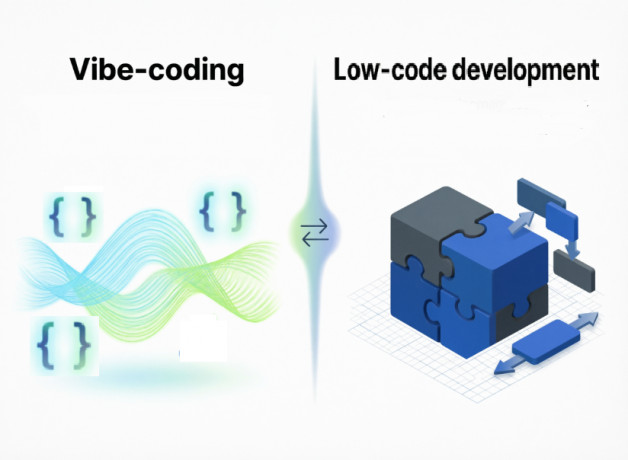
At first glance, it may seem like the end of traditional software development. But in reality, vibe coding does not replace low-code platforms. Instead, it makes them even more powerful.
Low-code and AI-assisted development solve different problems. Together, they create a new model for enterprise software development: faster, more flexible, and more manageable.
Research and industry practice show that companies adopt low-code not because it is trendy, but because it reduces time-to-market, lowers development costs, and decreases dependency on scarce engineering resources.
Vibe Coding Works Best for Rapid Prototyping
AI is extremely effective at:
- generating boilerplate code;
- creating MVPs;
- writing tests and documentation;
- generating SQL queries;
- building quick UI prototypes.
For startups and internal tools, this is a massive productivity boost.
However, enterprise software is not just code. It includes:
- architecture;
- security;
- compliance;
- integrations;
- scalability;
- reliability;
- governance;
- auditing;
- operational responsibility.
AI still cannot guarantee the stability and predictability required in enterprise systems. Even proponents of vibe coding admit that human oversight remains essential.
The Core Problem of Vibe Coding: Lack of Predictability
Low-code platforms were designed as controlled development environments.
That is the key difference between low-code and AI-generated coding.
Low-code platforms provide:
- standardized components;
- visual process modeling;
- centralized architecture;
- reusable modules;
- transparent workflows;
- governed integrations.
AI-generated code, on the other hand, is probabilistic by nature. Large language models do not truly “understand” business logic — they predict statistically likely outputs.
As a result, AI is excellent at:
- accelerating development;
- assisting engineers;
- automating repetitive tasks.
But it cannot guarantee engineering precision.
That is why low-code remains critically important for enterprise environments.
Why Enterprise Companies Still Choose Low-Code
Low-code platforms emerged because traditional development cycles became too slow for modern business environments.
Companies constantly face:
- regulatory changes;
- organizational restructuring;
- evolving business models;
- new integration requirements.
Traditional development often requires long delivery cycles:
Requirements → Development → Testing → Release.
Low-code dramatically reduces this cycle. Industry estimates suggest that low-code applications can be delivered 3–5 times faster than traditional software development.
More importantly, low-code provides capabilities that pure vibe coding still lacks:
Governance
Changes happen inside a controlled platform.
Repeatability
Processes and components are standardized.
Scalability
Architectures are designed for enterprise growth.
Transparency
Business users can understand and monitor workflows.
Reduced Technical Debt
Low-code minimizes fragmented custom solutions.
In High-Risk Industries, Precision Matters More Than Speed
Some industries cannot tolerate unpredictable behavior:
- healthcare;
- legal services;
- finance;
- government systems;
- industrial automation;
- cybersecurity.
In these environments, software errors can lead to:
- legal consequences;
- financial damage;
- data breaches;
- risks to human safety.
AI systems still hallucinate — producing convincing but incorrect outputs.
That makes AI unsuitable as the sole source of business-critical logic.
Low-code platforms provide safer foundations through:
- verified components;
- controlled workflows;
- auditability;
- standardized behavior;
- embedded security controls.
AI can accelerate engineers, but accountability still belongs to humans and governed platforms.
The Future Is Not “Low-Code vs AI” — It’s “Low-Code + AI”
The most realistic future is the convergence of these approaches.
AI becomes a new interface for low-code platforms.
Instead of manually configuring systems, users will increasingly:
- describe business logic in natural language;
- auto-generate forms and workflows;
- create integrations conversationally;
- receive architectural recommendations.
But execution will still happen inside a governed low-code environment.
This combination creates the best balance:
- AI delivers speed;
- low-code delivers control and reliability.
Research already shows that AI and low-code complement each other rather than compete.
AI Does Not Replace Engineers — It Changes Their Role
Every major abstraction shift in software development triggered similar fears.
Frameworks did not eliminate developers.
Cloud computing did not eliminate infrastructure engineers.
Instead, software engineering evolved toward higher abstraction layers.
Low-code and AI continue that trend:
- reducing routine work;
- accelerating repetitive tasks;
- lowering barriers to entry;
- helping businesses move faster.
But complex engineering remains essential.
In fact, architects and enterprise engineers become even more valuable because they ensure:
- reliability;
- scalability;
- security;
- governance;
- regulatory compliance.
Vibe coding is not a replacement for low-code. It is a new capability inside the modern software development ecosystem.
AI is excellent at accelerating code generation. But enterprise software development is far more than writing functions.
Corporate systems still require:
- governance;
- standardization;
- architectural stability;
- security;
- reliability;
- controlled change management.
That is why low-code platforms will not disappear because of AI. On the contrary, they will likely become the primary environment where AI capabilities are applied safely and effectively.
The future is not “humans vs AI” or “low-code vs vibe coding.”
The future is governed development powered by artificial intelligence.