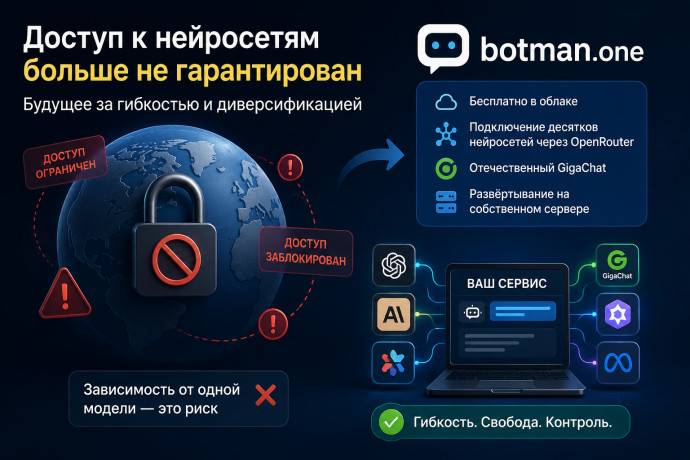
Not long ago, it seemed that access to advanced AI models was simply a matter of budget. If a company could afford it, it could use the world's best AI models and build products around them.
Recent events have shown that the reality is becoming much more complicated.
One of the most anticipated AI models was recently released to the public. However, just hours after launch, access to the model became uncertain due to regulatory concerns and restrictions related to national security. As a result, the model was temporarily unavailable to users outside certain jurisdictions.
This situation sends an important signal to the entire AI industry.
The Biggest Risk for AI Projects Today Is Dependence on a Single Provider
Most modern AI-powered services rely heavily on a single model or a single provider.
This approach works well until external factors appear:
- Changes in access policies
- Regulatory restrictions
- Geographic limitations
- Sharp increases in API pricing
- New usage limits and quotas
- Model deprecation or service shutdowns
When critical business processes depend on one provider, any of these changes can significantly impact a product or even stop it from functioning altogether.
This risk affects not only large enterprises but also startups, independent developers, and everyday users who rely on AI tools in their work.
Access to the Best Models Is No Longer Guaranteed
Many people have assumed that technology services would remain equally accessible around the world. However, AI is increasingly becoming a strategic technology sector.
Governments are beginning to treat advanced AI models as strategic assets. This means that access restrictions may become more common in the future.
Today, one model faces restrictions. Tomorrow, it could be another.
In this environment, those who prepare in advance and avoid dependence on a single provider will have a significant advantage.
Diversification Is Becoming a Necessity
For any AI-powered business, the ability to switch between different models and providers is becoming essential.
This provides several benefits:
- Business continuity during service disruptions
- Greater flexibility in managing costs
- Access to the best model for each specific task
- Reduced exposure to political and economic risks
- Freedom from dependence on a single vendor
Just as companies diversify suppliers and sales channels, AI projects must diversify their AI infrastructure.
How Botman.one Helps
This is exactly why Botman.one was designed around flexibility and technological independence.
The platform is available for free in the cloud and allows users to connect to a wide range of AI models through OpenRouter, providing access to multiple leading international AI providers through a single interface.
At the same time, users can work with domestic solutions, including GigaChat.
This approach allows businesses to:
- Quickly switch between models
- Test and compare different AI systems
- Avoid dependence on a single provider
- Optimize performance and costs
If one model becomes unavailable or significantly more expensive, there is always an alternative available.
Independence Not Only from AI Models but Also from the Platform
There is another important consideration.
Even when using a convenient low-code platform, businesses can become dependent on the platform itself.
What happens if pricing changes? What if new limitations are introduced? What if the platform changes its policies?
Botman.one minimizes these risks.
All services built on the platform can be deployed on your own server. This means developers and businesses retain full control over their infrastructure and can continue operating independently.
In practice, users gain two levels of independence:
- Independence from a specific AI model.
- Independence from a specific development platform.
The Future Belongs to Flexible Solutions
The AI landscape is changing rapidly. Models evolve, pricing changes, regulations emerge, and access policies shift.
In such an environment, relying on a single provider becomes a growing risk.
A much more sustainable strategy is to build AI products that can work with multiple models while maintaining control over their infrastructure.
The key question is no longer which AI model is the best.
The real question is how quickly you can switch to another one when circumstances change.
That is exactly the kind of flexibility that Botman.one provides.