Anyone who regularly works with AI has experienced situations where a model starts mixing up facts, overlooks important details, or produces inconsistent conclusions. In many cases, the problem is not the model itself but the limitations of its context window.
What Is a Context Window?
A context window is the amount of information an AI model can consider while generating a response. It includes your prompt, previous conversation history, system instructions, and the content of uploaded documents.
As more information is added, the model has to distribute its attention across a larger amount of data. Eventually, some details receive less attention, reducing the overall quality and consistency of the output.
This becomes especially noticeable when working with lengthy contracts, technical documentation, research papers, knowledge bases, or other large collections of documents.
Why Task Decomposition Works Better Than Simply Increasing Context Size
Modern language models continue to expand their context windows, but larger contexts do not eliminate the underlying challenge.
Larger contexts increase computational cost, may reduce reasoning quality when too much information competes for attention, and fail to reflect the fact that many real-world tasks naturally consist of multiple sequential steps.
For this reason, advanced AI systems increasingly rely on workflows made up of multiple focused prompts instead of one massive request.
How the Botman One AI Orchestrator Solves This
The AI orchestrator built on the Botman One platform automates this entire process.
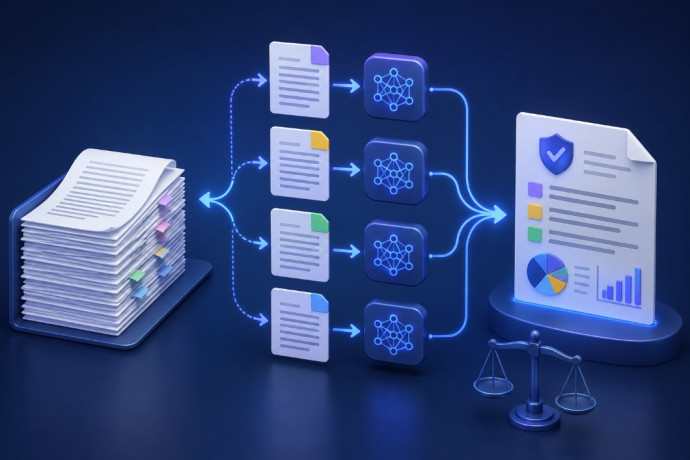
Instead of sending an entire document to a single model request, it can automatically:
- split large documents or complex tasks into logical sections;
- generate separate prompts for each processing stage;
- assign different AI models or specialized AI agents to different subtasks when needed;
- collect intermediate results;
- combine all outputs into a single structured document.
Users no longer need to create dozens of separate chats, manually copy summaries, or monitor context limits. The entire workflow is executed automatically within a single AI process.
Example Workflow
Imagine reviewing a 300-page contract.
Instead of processing everything in one request, the orchestrator can:
- Divide the document into sections.
- Analyze each section independently.
- Extract risks and key contractual terms.
- Validate findings against internal company policies.
- Generate a consolidated report with recommendations.
Each processing step operates within a focused context, improving accuracy while preserving important details throughout the workflow.
The same approach can be applied to technical documentation, scientific publications, project documentation, procurement materials, corporate policies, knowledge bases, and virtually any large collection of information.
AI Orchestration Instead of Manual Prompt Chaining
Many experienced AI users already perform similar workflows manually by creating multiple conversations, generating summaries, splitting documents, and combining intermediate outputs.
The Botman One AI orchestrator automates this approach.
Instead of repeating the same routine for every project, users design the workflow once, while the platform manages prompt sequencing, context transfer, intermediate processing, and final document generation automatically.
Conclusion
Context window limitations are not flaws of modern language models—they are a fundamental characteristic of how they operate.
The most effective way to process large volumes of information is not to force everything into a single prompt, but to intelligently decompose the task into smaller stages.
This is exactly the approach implemented by the Botman One AI orchestrator, enabling organizations to automate complex AI workflows, process large documents more accurately, and generate high-quality results without being constrained by context window limitations.