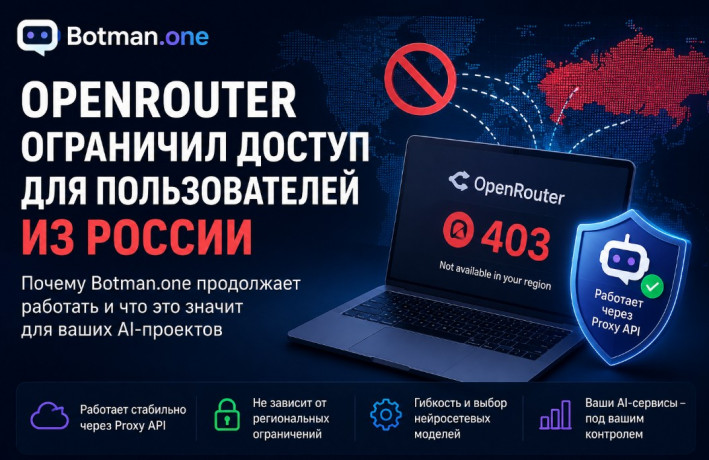
Recent reports indicate that OpenRouter, one of the most popular aggregators of large language models, has stopped serving users located in Russia. According to developers, requests originating from Russian IP addresses now return a 403 "Not available in your region" error. In many cases, even VPNs do not solve the issue.
For many developers, this came as an unpleasant surprise. AI chatbots, agents, and production services that relied on direct OpenRouter connectivity suddenly stopped working for users accessing them from Russia.
What about Botman.one?
For Botman.one users, there is no reason to worry.
On our platform, OpenRouter is connected through the Proxy API service, so the current regional restrictions do not affect projects built on Botman.one. AI assistants, chatbots, and automation workflows continue operating normally.
A Growing Industry Trend
The OpenRouter situation is far from unique.
Over the past few years, more and more international AI providers have introduced regional restrictions, limited registrations, blocked web interfaces, or restricted access for users from specific countries.
These changes often happen without prior notice and can immediately impact businesses that rely directly on third-party AI platforms.
For companies building AI products, this creates unnecessary operational risk: a service that works today may become unavailable tomorrow.
Why API-Based Infrastructure Is More Reliable
In many cases, regional restrictions primarily affect public web interfaces rather than API integrations supported through specialized infrastructure.
This is why an increasing number of businesses are moving away from depending on individual AI websites and instead building their own AI products on top of API-based infrastructure.
Such an architecture provides greater flexibility and significantly reduces dependency on any single provider.
Build Your Own AI Services with Botman.one
Botman.one enables developers and businesses to create custom AI assistants, chatbots, and automation workflows while connecting to multiple AI models through APIs.
This approach offers several important advantages:
- reliable operation without depending on public web interfaces;
- flexibility to switch AI providers when needed;
- centralized management of AI services;
- greater resilience against regional restrictions and provider policy changes.
The OpenRouter case is another reminder that modern AI infrastructure should not depend entirely on a single external platform. Building AI services through APIs and a flexible integration platform helps businesses remain stable even when international providers change their access policies.
If you're developing AI-powered products—or planning to launch one—it's worth investing in an architecture designed for long-term reliability. That is exactly the approach Botman.one provides.