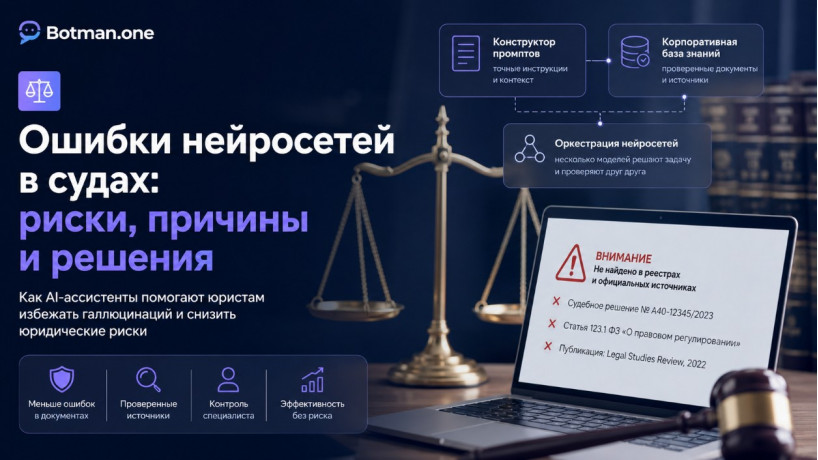
Artificial intelligence is rapidly transforming the legal profession. Lawyers increasingly rely on AI to research information, analyze documents, draft contracts, and prepare procedural filings. At the same time, the growing adoption of AI has introduced a new challenge: fabricated legal references that are making their way into court documents.
According to recent research highlighted by the media, courts around the world are increasingly encountering filings containing non-existent court decisions, legal provisions, academic publications, and judicial precedents generated by AI systems. The primary cause is the use of generative AI without verifying the information it produces.
Researchers estimate that thousands of such cases have already been identified, while court sanctions related to AI-generated false legal citations have exceeded $1.6 million worldwide.
Why Do These Errors Occur?
Most popular AI models are designed as general-purpose language models. Their objective is to generate the most likely response to a prompt—not to guarantee the legal accuracy of every citation or legal reference.
As a result, an AI model may confidently produce a court decision that does not exist, confuse statutory references, or combine several legitimate sources into a fictional one. This phenomenon is commonly known as an AI hallucination.
The core issue is not the technology itself but excessive reliance on AI-generated output. When legal professionals use AI-produced content without verifying the underlying sources, the risk of serious errors increases significantly.
Why General-Purpose AI Is No Longer Enough
General-purpose AI remains highly valuable for many everyday legal tasks. It can help lawyers:
- organize information;
- draft initial versions of documents;
- formulate legal arguments;
- reduce preparation time.
However, professional legal practice requires a much higher level of accuracy and accountability.
For this reason, the legal industry is increasingly adopting specialized AI assistants that work with verified legal databases, understand jurisdiction-specific requirements, and are designed specifically for legal research and drafting.
Internationally, platforms such as Harvey AI and CoCounsel have become well-known examples of this trend. In Russia, Yandex's NeuroLawyer follows a similar approach. These specialized systems significantly reduce the likelihood of fabricated legal references while integrating verification directly into legal workflows.
AI Does Not Replace Professional Responsibility
Even the most advanced AI tools do not eliminate a lawyer's professional responsibility.
Regardless of how a document is created, legal professionals remain responsible for:
- the accuracy of legal arguments;
- the reliability of cited case law;
- correct statutory references;
- the final content of procedural documents.
Courts evaluate the submitted legal document—not the AI system that helped prepare it. Human review therefore remains an essential part of every legal workflow.
How to Use AI Responsibly
Experience shows that AI delivers the greatest value when it becomes part of a controlled legal process.
Best practices include:
- using specialized legal AI solutions;
- verifying every legal citation and case reference;
- relying on internal knowledge bases;
- automating routine work while maintaining expert review of final documents.
This approach allows organizations to improve productivity while minimizing legal risks.
The Role of Low-Code Platforms
Modern low-code platforms enable organizations to build their own AI assistants tailored to internal policies, corporate knowledge bases, and professional legal information systems.
This approach helps standardize document preparation, reduce errors, and introduce additional quality controls when using AI in legal practice.
As artificial intelligence continues to evolve, it is becoming an essential tool for lawyers—but not a replacement for legal expertise. The combination of automation, verified legal sources, and professional responsibility remains the foundation for the safe and effective use of AI in the legal industry.