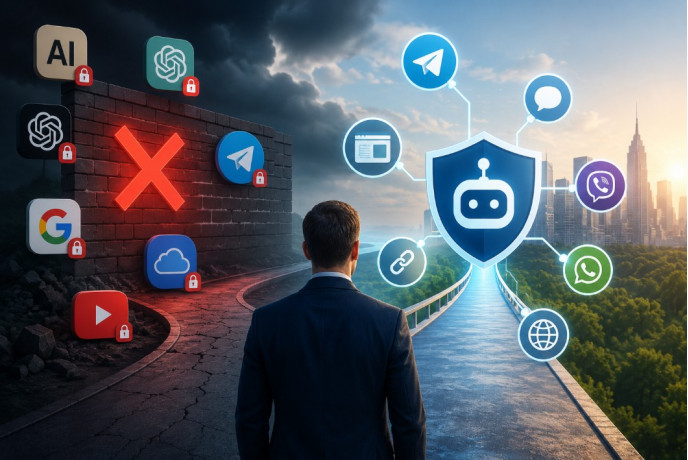
For years, companies relied on international online services as the foundation of their digital infrastructure. AI assistants, messaging platforms, cloud APIs, and automation tools became critical parts of everyday business operations.
Today, that strategy carries growing risks.
Russian users increasingly face account suspensions, payment restrictions, API limitations, and even complete service shutdowns. At the same time, some foreign platforms are becoming harder to access due to domestic internet restrictions.
Recent examples include:
- Claude blocking Russian accounts, including paid subscriptions.
- OpenRouter restricting access to major AI models such as ChatGPT, Claude, and Gemini for Russian accounts while limiting payments.
- Ongoing restrictions affecting Telegram availability and functionality inside Russia.
For businesses, this creates a serious dependency risk. If customer communication relies on a single messenger or AI provider, one policy change can disrupt operations overnight.
The solution is diversification.
Instead of depending on one platform, businesses should be able to switch communication channels without rebuilding their services.
Botman.one was designed with this approach in mind. Services created on the platform can be published simultaneously through multiple messengers, embedded as website widgets, launched as standalone web pages, or shared directly via a hosted link—even if a company has no website.
The same principle applies to AI models. Through API integrations, Botman.one allows developers to replace one AI provider with another when access restrictions or business requirements change.
The future is uncertain, but resilient digital architecture is not. Companies that diversify communication channels and AI providers today will be better prepared for tomorrow's restrictions.