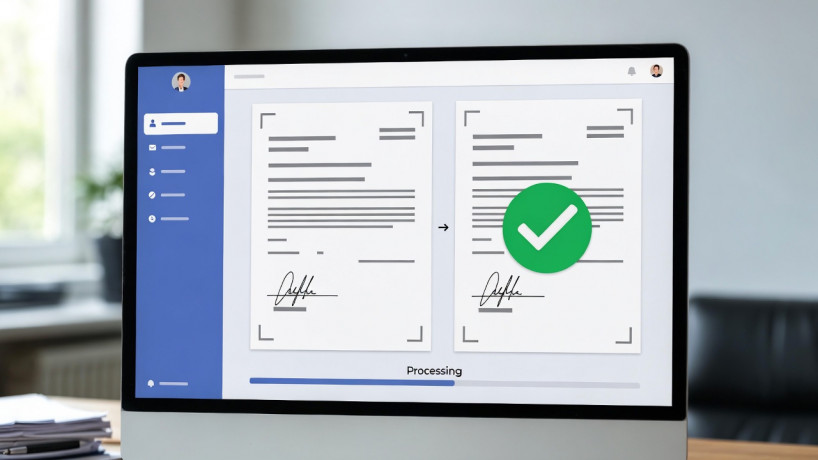
Manual entry of details from a contract into a CRM or document templates is not only tedious but also prone to errors. It's even more challenging to promptly check a counterparty's status: whether it is active, in the process of liquidation, or bankrupt. However, this process can be made fast, accurate, and not requiring constant attention.
You can create such a solution by combining the capabilities of the Botman.one low-code platform with modern neural networks and the Dadata API service. You can build a service that automatically extracts details even from a scanned contract, verifies the counterparty via the Dadata service, and inserts the correct data into any documents.
How It Works: Automation Workflow
-
Document Upload. The user uploads a contract (PDF or even a scanned image) via a form in a Telegram bot, on a website, or in the Botman.one interface.
-
Text Extraction. If the document is an image, the system uses an OCR service, built-in, for example, in the DeepSeek neural network, to recognize the text. For text files, this step is skipped.
-
Detail Extraction. The neural network analyzes the text and finds key data: Taxpayer Identification Number (INN), Primary State Registration Number (OGRN), company name, address, bank details.
-
Counterparty Verification. The obtained INN is sent to the Dadata service API to receive up-to-date data from the Unified State Register of Legal Entities (EGRUL) and check the status (active, in liquidation, bankrupt).
-
Document Generation. The verified details are automatically inserted into pre-prepared document templates in the Botman.one constructor, for example, into an act, a new contract, or an invoice.
-
Result. The finished document and the verification result are sent to the user.
Technical Implementation: Key Components
-
Working with Documents and Neural Networks in Botman.one
The Botman.one platform is ideal for orchestrating the entire process. You can use the built-in functionality for file uploads (the "Additional Info" block), and for interacting with the neural network API and the Dadata service API - the "Action" block. It allows sending HTTP requests to any external APIs.
For Russian users, it's most convenient to send requests to GigaChat (after registering there and obtaining a key). If you wish to use foreign neural networks, you can pay for access to them in rubles via the Proxy API service, obtain a key from Proxy API, and insert it into the corresponding field in the "Action" block settings.-
Text Extraction (OCR): In Botman.one, you configure a request to a neural network API capable of recognizing text in an image, for example, DeepSeek, send the file, and receive the recognized text. For this, in the "Action" block, you need to select the type "AI request" and then configure the parameters: insert the key for the neural network API, obtained from the Proxy API service (for foreign neural networks) or the GigaChat key.
-
Text Analysis by Neural Network: Using a correctly composed prompt, you can accurately extract structured data from the document. For example, the prompt could be: "From the following contract text, extract the INN, OGRN, full legal entity name, legal address, and settlement account. Output the result in JSON format."
You need to insert this text into a pre-created "Message" block. Then, after creating the "Action" block, which is created to send the document to the neural network, you will also need to configure:
-
That the "Action" takes the document file for analysis from the "Additional Info" block (the user of your service will upload the document file into Additional Info, after which it will be sent to the neural network);
-
That the prompt for the neural network, the "Action", takes from the "Message" block.
-
-
Verification via the "Dadata" API
Dadata provides an API for obtaining data about organizations by INN or OGRN. The response contains not only current details but also the key company status:-
ACTIVE — active.
-
LIQUIDATING — in the process of liquidation.
-
LIQUIDATED — liquidated.
-
REORGANIZING — in the process of reorganization.
-
BANKRUPT — bankrupt.
In Botman.one, you configure an external request to the Dadata API also via the "Action" block, inserting the INN extracted from the document by the neural network into the settings of this action. The response is parsed, and the company status is saved into a variable for further use.
-
-
Assembling the Final Solution
All these stages are linked into a single scenario (funnel) within Botman.one. The platform allows:-
Handling logic branching (for example, if the company status is not ACTIVE, send a warning).
-
Automatically filling document templates with verified data.
-
Sending the final files to the user via email, Telegram, or saving them to cloud storage.
-
Benefits of the Approach
-
Speed. A process that took hours is completed in minutes without human involvement.
-
Accuracy. Typos when transferring details are eliminated. Data is always up-to-date and taken from an official source (EGRUL).
-
Security. Automatic verification of a company's status minimizes the risks of working with unreliable counterparties.
-
Flexibility. The scenario can be adapted to any type of document and business processes: from verifying counterparties in the procurement department to automatically processing contracts in the sales department.
-
Accessibility. Creating such a solution does not require programming knowledge - an understanding of the process logic and the ability to work with Botman.one's low-code tools is sufficient.
Integrating Botman.one with neural networks and external APIs opens up powerful possibilities for automating routine and critical tasks. The described case of counterparty verification is just one example. The low-code platform allows for quick prototyping, testing, and implementation of such solutions, significantly increasing efficiency and reducing operational risks.
Ready to automate your work with documents?
Start by exploring the capabilities of Botman.one and creating your first bot.