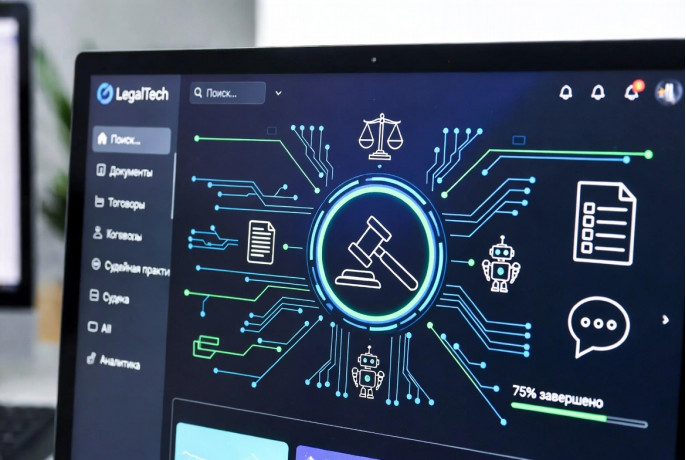
The legal profession in Russia is undergoing a stage that could be called "digital maturity." Five to seven years ago, automation was perceived as an option — useful but not essential. Today, it's a matter of competitiveness and market survival. The LegalTech market in the country boasts over a hundred active solutions, and this number continues to grow. Looking at the dynamics of the last two or three years, a clear shift is visible from disparate tools to comprehensive platforms. This isn't just a fad for "ecosystems" — it's a demand from businesses tired of jumping between ten browser tabs.
The State as a Pioneer
The history of Russian legal digitalization didn't start with commercial startups but with the state. This is an important point to understand, because it was government services that accustomed lawyers to working digitally.
The Arbitration Cases Register (KAD) was, without exaggeration, a revolution. Before its appearance, tracking litigation was like a detective investigation. Now, all information is open, structured, and accessible to any user. The "My Arbitr" system allowed documents to be filed with courts without leaving the office, while the SAS "Justice" (GAS Pravosudie) gradually brought the courts of general jurisdiction into the digital fold.
Yes, there are questions about these systems' interfaces, and their performance can be inconsistent, but the fact remains: they set a standard for transparency and forced lawyers to believe that digital is reliable.
The Commercial Segment: Finding Growth Points
Business followed the state's lead. The market quickly filled with products targeting specific tasks.
In the field of contract and document management, notable players include Doczilla, Freshdoc, and Profdoc. They addressed the need for quickly creating standard documents and controlling versions.
In judicial practice analytics, products from the company Pravo Tech — Casebook and Caselook — stood out. They allow not just searching for judicial acts, but also analyzing judge statistics and assessing the prospects of disputes.
Legal reference systems — ConsultantPlus and Garant — must also be mentioned. They have long been a standard for any Russian lawyer and have been actively integrating elements of artificial intelligence into their products in recent years. For example, Garant is developing an AI assistant called "Iskra" to assist with document selection and analytics.
However, there's a nuance here. Most of the mentioned solutions are highly specialized. They do one thing excellently but don't cover the entire legal function comprehensively. Businesses need flexibility: the ability to quickly assemble their own service, combining contract management, employee consulting, compliance, and training. It's this demand that is shaping the need for platform solutions.
Artificial Intelligence: From Experiments to Practice
Any discussion of LegalTech today is unthinkable without mentioning AI. After the neural network boom of 2023–2024, many lawyers developed either an enthusiastic or panicked attitude towards the technology. Reality, as usual, lies somewhere in between.
Currently, neural networks (both Western — ChatGPT, Claude, Gemini — and domestic developments based on open models) are used by lawyers quite pragmatically.
What works well:
-
Drafting documents. The neural network is excellent at generating a "skeleton" of a contract or claim. The lawyer then edits it, but spends less time.
-
Initial analysis and summarization. The speed of processing large volumes of text is higher for AI than for humans. You can feed 50 pages of a judicial act to a model and get a summary in a couple of minutes.
-
Audio transcription. Converting recordings of negotiations or court sessions into text is routine work that a machine can handle.
However, it's crucial to understand the limitations. Neural networks can "hallucinate" — invent non-existent norms or court decisions. Cases where inexperienced lawyers have presented references to fictitious cases in court have already become cautionary tales. Furthermore, the issue of data security is acute. Uploading commercial contracts to open cloud services could lead to leaks. Today, large companies solve this problem either through strict internal regulations or by deploying AI models on their own servers.
The Platform Approach: A Paradigm Shift
While some vendors develop point products, others have moved towards creating universal development environments. The logic is simple: it's impossible to anticipate every specific need of a legal department or consulting practice. Therefore, lawyers need to be given a tool with which they can automate themselves.
Here, it's worth highlighting the Botman.one platform, which differs markedly from classic LegalTech solutions.
What is Botman.one?
At its core, it's a low-code platform. It's not designed for one specific task but allows users to create their own applications without writing code. For the legal market, this means fundamentally new possibilities.
Using the platform's builder, lawyers can independently develop:
-
Document builders. Not just simple templates, but systems with branching logic: depending on the data entered by the user, the contract is generated with different terms.
-
Intelligent chatbots. Bots powered by neural networks can advise employees on standard questions, relieving the legal department.
-
Business process navigators. Interactive instructions that guide an employee step-by-step: from a request to approve a transaction to final signing.
-
Training and testing systems. Allow for quickly creating courses and testing staff knowledge on new regulations or legislative changes.
-
Internal consulting and compliance services. For example, an ethics hotline or counterparty verification tools.
Deployment Flexibility
A particularly important point is security. In the legal sphere, this is critical. Solutions created on Botman.one can operate in two ways:
-
Cloud version. Suitable for small and medium-sized companies that value speed of launch and want to avoid server maintenance costs. Pricing scales based on needs.
-
On-premise deployment (local server). An option for large corporations and organizations with heightened data protection requirements. In this case, all information remains within the company's perimeter.
Monetization Capability
Another feature of the platform worth noting is its built-in functionality for commercialization. A user can not only create a service for themselves but also provide paid access to it. Essentially, a lawyer or consulting firm gains the ability to launch their own LegalTech startups without involving developers or investing in infrastructure. This changes the economics of the legal business: an opportunity arises to earn not just from hourly billing but also from digital products.
Russian Vendors on the LegalTech Map
Speaking about the market as a whole, one cannot limit the discussion to a single platform. In recent years, a stable pool of Russian developers has formed, covering different segments.
In the area of legal process management, PravoTech is active (developing not only analytical products but also AI solutions). In contract work, Freshdoc and Doczilla hold strong positions. For automating internal processes and communications, companies often use customized solutions based on Bitrix24.
But, to reiterate, the key difference of platforms like Botman.one from the listed products lies in the degree of freedom. Where a ready-made solution dictates the logic of work, a platform allows the logic to be customized.
The Market and Its Readiness
Objectively assessing the situation, mass "digitalization" of lawyers hasn't happened yet. Most practicing specialists still work the old-fashioned way, using Word, Excel, and intuition. However, the dynamics of recent years are encouraging.
Educational programs are emerging, corporate universities are introducing LegalTech courses, and conferences are increasingly discussing not abstract prospects but concrete case studies. It's likely that in the next two to three years, proficiency in automation tools and skills in working with neural networks will become not an advantage for a lawyer, but a basic competency.
Russian LegalTech has traveled the path from electronic court services to complex AI assistants and platform solutions. The next stage is consolidation. Businesses need not separate programs, but an environment where they can assemble everything necessary: from a document builder to a consultant bot.
The Botman.one low-code platform appears in this context as a response to market demand. It allows lawyers to independently create the services they need, not depend on developers, ensure data security, and even monetize their developments. Technologies are ceasing to be an external factor and are becoming a tool that a lawyer can customize for themselves. And this seems to be the direction in which the market will continue to move.